The Pilot-to-Production Gap
Why 95% of enterprise AI pilots produce zero measurable return, and why the gap isn't closed by buying more tokens.
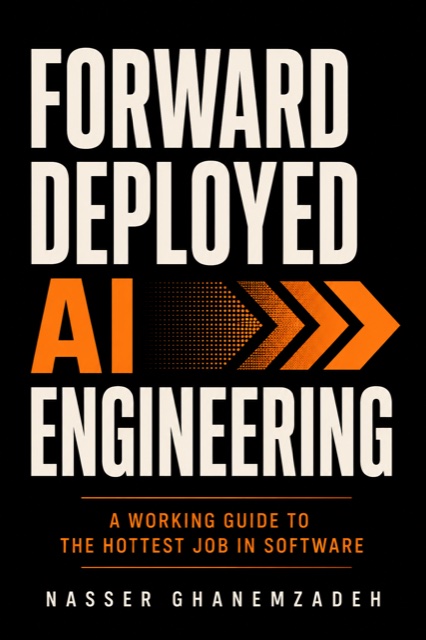
The Forward Deployed Engineer book: a working guide to the role OpenAI and Anthropic just put on the map.
A Working Guide to the Hottest Job in Software
For eighteen months before May 4, 2026, the Forward Deployed Engineer was already the most-discussed engineering role in the industry. Then the two most valuable private AI companies announced, on the same day, that they were creating new entities to put their engineers inside their customers' offices and ship working AI systems. OpenAI capitalized its vehicle at $10 billion. Anthropic at $1.5 billion. Same title. Same playbook. This book is for the person who wants to do that work.
Or read the sample chapters (PDF) now. Sign up and they land in your inbox.
You'll also get the newsletter. One email a week, easy unsubscribe.
02 · Who this is for
The book is written for three people specifically. The chapters are ordered for each of them in turn.
03 · What you'll be able to do
The book is the FDE playbook, engineered around four working outcomes. Finish it and a reader should be able to do all four.
04 · Structure
Part I. The Landscape. What the role is, where it came from, and why the AI moment has made it the default operating model of the industry.
Part II. The Mindset and the Method. The four traits that distinguish people who succeed at this work. The Echo and Delta split that organizes the work into two halves of one craft. The three-phase engagement that gives the work its rhythm. The gravel-road-to-highway pattern that makes the work compound into product.
Part III. The Craft. Discovery, evaluation, shipping the first slice, integrating with the enterprise stack, and closing the loop.
Part IV. Becoming an FDE. The paths in. The portfolio. The interview loop. The first year on the inside.
Part V. Economy and Future. Pricing, outcomes, contracts. Cargo cults and failure modes. The FDE diaspora the labs are producing whether they want to or not. A closing note for the buyer.
05 · Anchor chapters
Why 95% of enterprise AI pilots produce zero measurable return, and why the gap isn't closed by buying more tokens.
Two decades of FDE practice at Palantir. How it escaped that niche and became the default model for OpenAI, Anthropic, and the labs that followed.
Echo is the deployment that's working now. Delta is the change that makes the next one work better. Most engineers are good at one. FDEs do both.
The rhythm every FDE engagement follows, and the specific moves at each phase that separate the engagements that ship from the ones that drift.
In FDE work the eval is the spec. How to write one that customers will sign, engineers can build against, and the model can be measured on.
What the loop actually tests. The case study, the writing sample, the customer simulation. How to prepare for each, with worked examples.
Day rates, project rates, outcome rates, and equity. When each works. The contractual language that protects both sides.
The five ways FDE engagements fail. Each one is recoverable if you catch it by the second week.
06 · Why now
Most of the canonical literature on the role was written between September 2025 and April 2026. Some of it was written while this book was being drafted. The Anthropic and Blackstone joint venture, the OpenAI Deployment Company, the Google Cloud hires, the Big Four repositionings were news, not history, when the manuscript was working through draft. The book is written to still be useful three years from now, but the snapshot dimension is real, and a reader picking it up in 2029 will need to interpret the contemporary references through whatever has happened by then.
One principle is most likely to outlast the specific organizations and titles around it. The artifact is the truth. The code shipping is the substance. The document is the imitation. Everything else in the book is an unpacking of that.
07 · About the author

08 · Read it
Join the launch list and the first chapters land in your inbox now. The full Kindle and paperback editions are available on Amazon today.
You'll also get the newsletter. One email a week, easy unsubscribe.
Three readers in particular. Early-career engineers (3 to 5 years in) who recognize something in the FDE job description that fits how they want to work. Mid-career switchers (consultants, solutions architects, PMs, ex-founders) who suspect they already have most of the skills. Founders and hiring managers building an FDE function for the first time. If none of those descriptions fits you, the book has failed at scoping.
304 pages, organized into five parts and 20 chapters: the landscape, the mindset and method, the craft, becoming an FDE, and the economy and future. Plus a workbook and annotated references at the back.
Most AI books are about the models. This one is about the practice of deploying them inside someone else's company, with all the customer-side friction that implies. It is also written from inside that work, not from the bench.
First edition, May 2026. The current version is 1.5, August 2026. The full Kindle and paperback editions are available now on Amazon, and you can subscribe to the launch list above to read the first chapters.
Kindle and paperback are both available now on Amazon. You can also read the first chapters by subscribing to the launch list.
No. Independent publication. The book discusses these organizations because they shape the role, but the author is not affiliated with any of them. Views are the author's alone.